Big-Box Grooming Retreats in 2026, Independents Gain Ground
PetSmart and Petco tighten grooming safety rules and shrink footprints in 2026, opening real market share for independent salons ready to move.
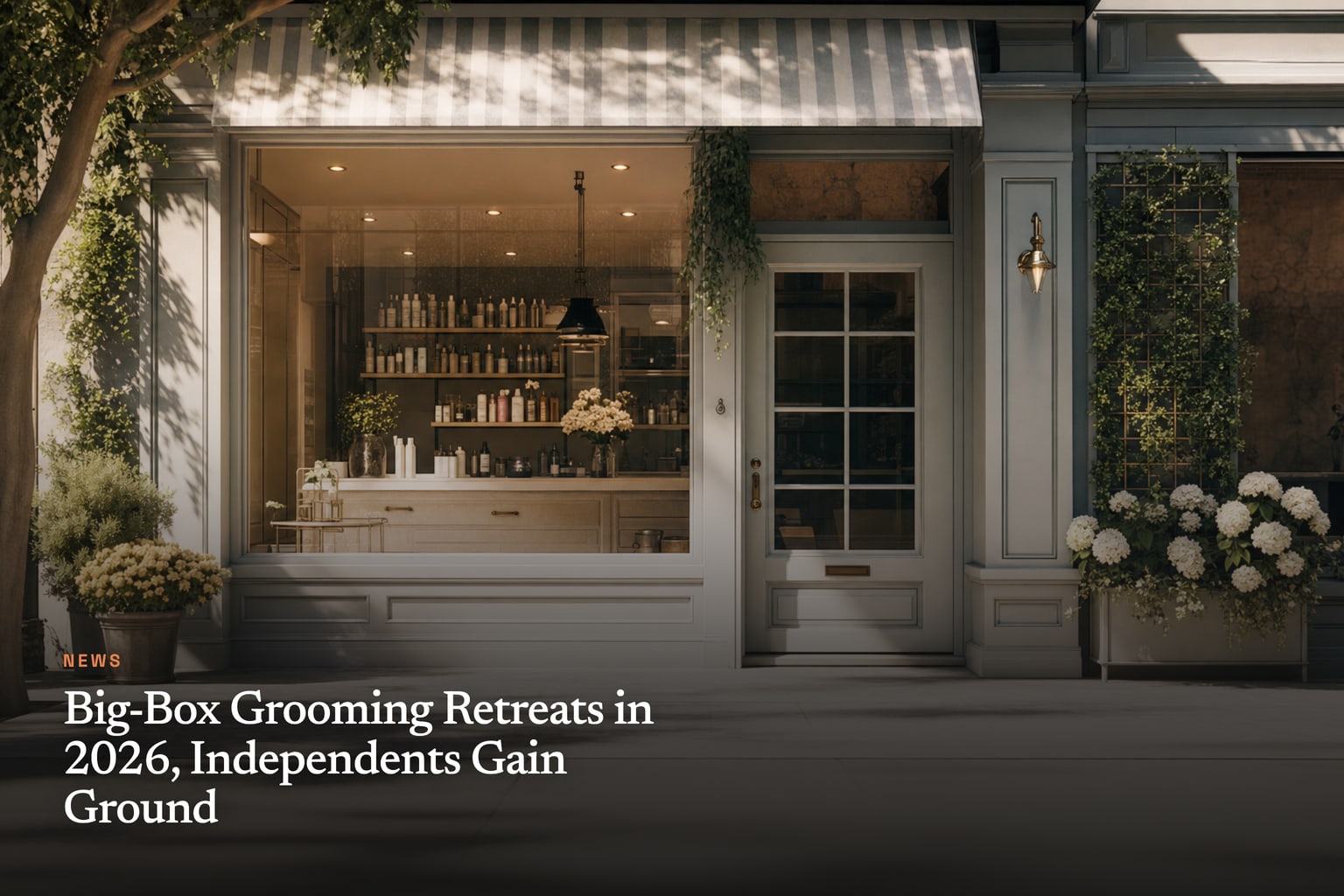
The Big-Box Grooming Pullback of 2026 Is an Independent's Opening
The two chains that trained a generation of American groomers are both playing defense right now. Petco spent much of 2025 closing underperforming locations and restructuring under CEO Joel Anderson, while PetSmart continues to operate under the shadow of grooming-safety legislation that lawmakers named after dogs that died in its salons. For independent salon owners, the story is not schadenfreude. It is a rare structural opening, and the window will not stay open forever.
Safety Legislation Reshapes the Grooming Table
The regulatory pressure on big-box grooming is no longer hypothetical. New Jersey passed "Bijou's Law" in early 2025, named after a dog that died at a PetSmart, requiring salons to notify owners immediately of any injury and mandating clearer training and reporting standards. Similar bills have circulated in New York, Massachusetts, and California, and the trend line points one direction: more accountability, more paperwork, more liability exposure for high-volume operators.
PetSmart and Petco have responded by tightening internal safety protocols. That means more required breaks for anxious animals, stricter brachycephalic breed policies, mandatory temperature and drying limits, and additional sign-off steps before, during, and after a groom. Each of those changes is defensible on welfare grounds. Each also slows throughput. When your business model depends on moving a set number of dogs through a station per day, a policy that adds ten minutes per pet is a direct hit to unit economics.
The chains cannot easily absorb that hit because of the second problem.
Why Volume Models Feel Safety Rules Hardest
It is worth understanding why the same rule that barely dents an independent can hurt a chain badly. A corporate salon is engineered around throughput. Stations are scheduled tightly, targets assume a certain number of dogs per groomer per day, and the whole store's grooming revenue is modeled on that pace. When a new protocol adds handling time to every animal, it does not just slow one dog, it compounds across every station, every shift, every location. An independent groomer who already works at a measured pace and takes the time a nervous dog needs absorbs a new rule with little disruption, because the careful practice was often already there. The chain, by contrast, has to rewrite its labor math. That structural difference is why welfare legislation, however even-handed on paper, lands hardest on the highest-volume operators.
Staffing Was Already the Bottleneck
There is no national grooming workforce surplus. The occupation skews toward burnout, physical wear, and modest pay, and the certification pipeline is thin. Big-box salons have historically leaned on in-house academies to train new groomers, then watched a meaningful share of those graduates leave, often to open or join independent shops once they built a client book.
Layer safety-driven slowdowns onto a chronic labor shortage and the math gets ugly. A salon that cannot fully staff its tables already turns away business. A salon that also has to groom each dog more slowly turns away more. Wait times at corporate salons in many markets now stretch two to three weeks for standard appointments, a gap that sends frustrated owners searching for alternatives.
Groomers themselves are voting with their feet. The appeal of independent or mobile work is straightforward:
- Control over the daily schedule and the number of dogs booked
- A larger share of the revenue per groom
- Freedom to refuse dangerous or aggressive animals without corporate override
- No pressure to upsell retail products at the table
Every experienced groomer a chain loses is a potential competitor, and increasingly a well-trained one.
The Academy Pipeline Cuts Both Ways
For years the chains' training academies were their quiet strategic advantage. They could take someone with no experience and turn out a functional groomer, solving the pipeline problem that starves the rest of the industry. But that same pipeline now feeds their competition. A groomer trained at a corporate academy, seasoned on high volume, and equipped with a real client book is exactly the kind of hire an independent salon dreams of, and exactly the kind of person most tempted to leave when corporate pressure mounts. The chains effectively subsidize the training of their future rivals. As conditions inside big-box salons tighten under safety rules and pace demands, the outflow of these trained groomers accelerates, and the beneficiaries are the independent and mobile operators ready to receive them.
Footprint Math: Closures, Caution, and Cash
Petco's financial picture drove the clearest retreat. After a difficult stretch of losses and a stock that spent 2024 and 2025 well below its 2021 IPO price, the company moved to close weaker stores and prioritize profitability over expansion. Grooming, which requires dedicated square footage, trained labor, and now heavier compliance overhead, is exactly the kind of line item a cost-focused turnaround scrutinizes.
PetSmart, privately held under BC Partners, has not published the same public metrics, but the broader chain-retail environment gives little reason for aggressive salon expansion. The category is mature. New builds are rare. The strategic emphasis at both companies has shifted toward services that lock in recurring revenue, veterinary partnerships, and app-based booking, rather than adding grooming capacity in new markets.
The result is a national grooming footprint that is flat to shrinking at the top, even as demand holds up. Pet ownership expanded sharply during the pandemic years, and those dogs still need to be groomed. The American Pet Products Association has continued to report pet spending in the neighborhood of $150 billion annually, with services as one of the more resilient segments. Supply is tightening at the exact moment demand refuses to fall.
A Supply Gap, Not a Demand Problem
This is the crux of the opportunity, and it is worth stating plainly. The independents gaining ground in 2026 are not doing so because they invented demand or out-marketed the chains. They are stepping into capacity the chains can no longer serve. When corporate salons close, slow down, or book three weeks out, the dogs behind those appointments do not disappear. Their owners go looking. That is a supply gap created by the retreat of large operators, not a shift in what pet owners want. Understanding it that way changes the independent's strategy. The job is not to convince people to groom their dogs. It is to be visible, available, and trustworthy at the moment a frustrated owner starts searching for somewhere new.
What the Independent Playbook Looks Like Now
This is the part owners can act on. The opening is real, but it rewards operators who move deliberately rather than simply raising the "we're hiring" banner.
Recruit the refugees. The single fastest way to add capacity is to hire experienced groomers leaving the chains. They arrive trained, fast, and often with clients who will follow. Compete on autonomy and schedule, not just wage, because that is precisely what they left corporate to find.
Own the safety narrative. The same legislation squeezing big-box operators is a marketing gift for independents who genuinely do it well. Publish your handling protocols. Explain your breed policies. Offer to text owners photos mid-groom. The public conversation about grooming injuries has made pet owners more discerning, and transparency now converts.
Fix the wait-time gap. When the PetSmart down the road books three weeks out, "next available Thursday" is a competitive weapon. Online booking, clear pricing, and reliable turnaround win the customers those queues push away.
Do not overextend on safety compliance you cannot deliver. The flip side is unforgiving. An independent that markets itself as the safe choice and then has an incident faces the same headlines, without the corporate legal department. The bar the chains are being held to is the bar everyone will be judged against.
Capturing the Client, Not Just the Call
Winning the frustrated big-box customer takes more than being available once. The chains, for all their problems, are convenient, and an owner leaving one expects at least that much. An independent that answers the phone, books online without friction, sends a reminder, and delivers a clean, on-time groom has matched the convenience and beaten the wait. The next step is retention. A first visit from a chain refugee is worth little if the client drifts back to whatever is easiest. Automated rebooking prompts, a standing-appointment offer, and simply asking the client to book the next groom before they leave the shop turn a one-time defector into a recurring customer. Grooming platforms like Talopet, MoeGo, and Gingr put those tools within reach of a single-location shop, which means an independent can now offer the booking polish that used to be a corporate advantage while keeping the personal relationship a chain cannot replicate.
Timing the Window
The opening is real but it is not permanent. The chains are recalibrating, not surrendering, and a mature operator with real capital will eventually restaff, adjust its pace, and stabilize under the new rules. The independents who benefit most are the ones who move while the gap is widest, in 2026 and the year or two after, rather than waiting to see how it all settles. Adding a groomer, tightening the booking experience, and building a local reputation for safe, transparent handling takes months, not weeks. The owner who starts now is positioned when the demand arrives. The one who waits for certainty will find the window narrower and the best available groomers already hired.
The Bottom Line
The big-box grooming model is not collapsing. It is recalibrating, more slowly and more expensively than it would like, under real regulatory and labor pressure. That recalibration has opened a genuine supply gap in a market where demand has refused to fall. Independent owners who read the moment correctly, who staff up by recruiting the groomers leaving the chains, who market safety and transparency honestly, and who close the convenience gap with modern booking and reliable turnaround, stand to capture demand the chains can no longer serve fast enough. The advantage will not last indefinitely, which is exactly why the operators who act deliberately through 2026 are the ones who will still be gaining ground when the window closes.