Heated Dryer Safety: Cutting Heat Stress on the Table
Cage and force-air dryers are linked to fatal overheating in dogs. Here are the welfare risks, emerging protocols, and how salons are changing drying practices.
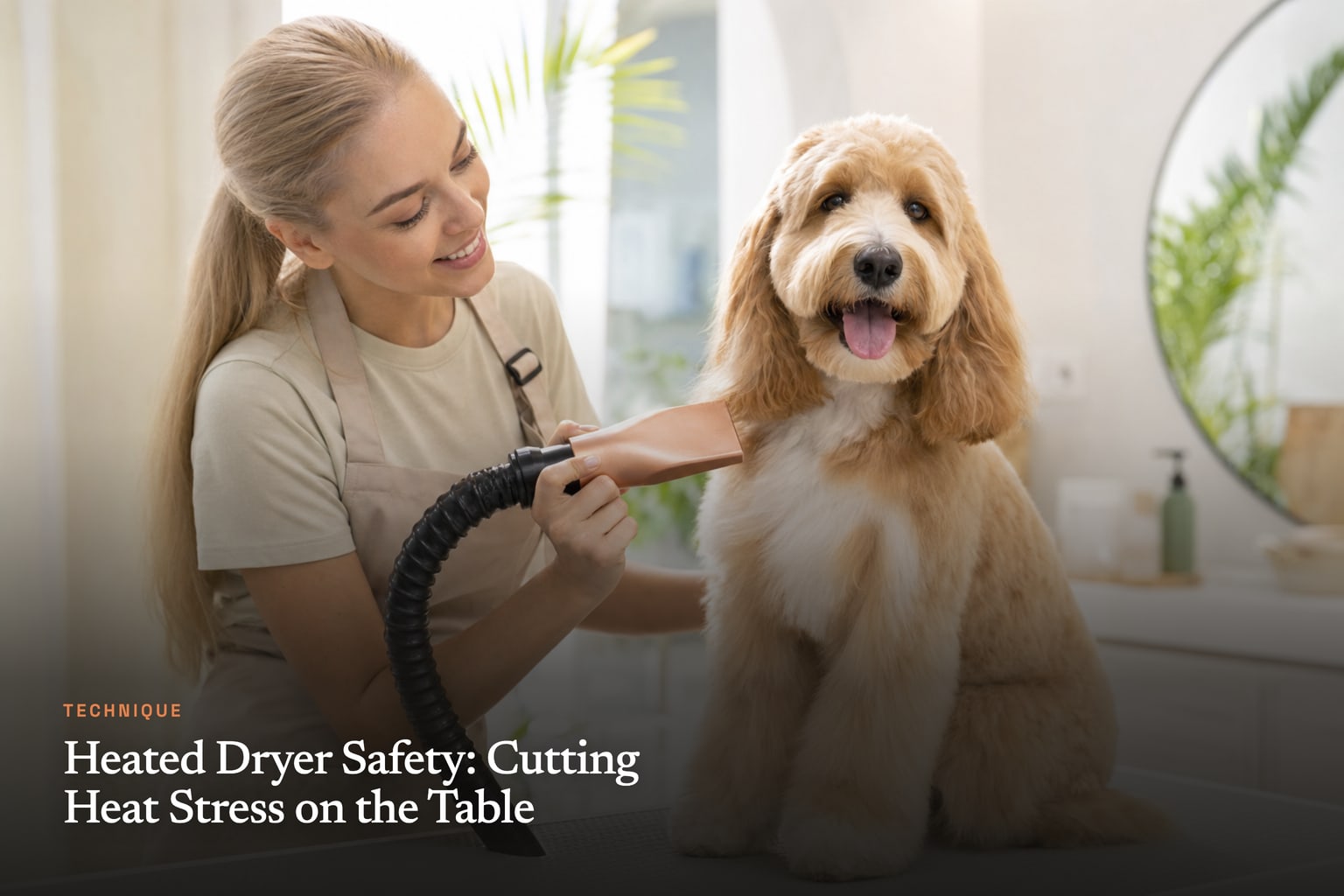
Heated Dryer Safety and the Fight Against Heat Stress on the Grooming Table
The cage dryer has quietly become one of the most litigated pieces of equipment in the grooming industry. Multiple wrongful-death claims filed against salons over the past decade trace back to the same scenario: a dog left in an enclosed kennel with a heated dryer running, discovered too late in acute heat stroke. The devices remain legal in most jurisdictions and widely used, but a growing body of veterinary and industry opinion now treats them as a serious welfare hazard rather than a routine tool.
For salon owners, the stakes are practical as much as ethical. A single fatal incident can end a business, trigger insurance disputes, and draw regulatory scrutiny in states that already license groomers. It can also follow an owner across every review platform and local news cycle for years, long after any settlement is signed.
Where the Danger Actually Sits
Two distinct pieces of equipment get conflated in this conversation, and the distinction matters. A heated cage dryer clips to or blows into an enclosed crate while the animal is confined. A high-velocity force-air dryer, held by a groomer at the table, uses air pressure rather than heat to push water off the coat. The force dryer is generally the safer design because a human is present and the primary mechanism is airflow, not temperature.
The cage dryer is the higher-risk category for a simple reason. It combines confinement, elevated temperature, and, too often, an unattended animal. Enclosed space limits convective cooling. A dog that begins to overheat cannot move away from the heat source. If no one is watching, the early warning signs go unread.
The American Veterinary Medical Association identifies heat stroke as a medical emergency, with body temperatures above roughly 106 degrees Fahrenheit causing organ damage and death. Panting, the dog's main cooling mechanism, becomes less effective in a warm enclosed airstream. That is the physiological trap.
The Physiology Groomers Should Understand
Dogs do not sweat efficiently. A small amount of thermoregulation happens through the pads of the feet, but the workhorse is evaporative cooling from the tongue, mouth, and upper airway during panting. That system depends on air that is cooler and drier than the dog's core. Inside a cage with a heated dryer running, the microclimate flips. The air warms, humidity rises from evaporating bathwater, and the panting reflex loses its edge. The dog works harder to breathe while getting less cooling in return.
Once the core temperature climbs past the point where the body can shed heat, the decline is fast and nonlinear. Cells begin to break down. The gut lining becomes permeable, blood clotting goes haywire, and the kidneys and liver take damage that can be fatal even after the dog is pulled from the crate and cooled. This is why heat stroke deaths sometimes happen hours later, at an emergency clinic, in a dog that looked like it had been rescued in time. The groomer sees a wet, panting dog and assumes it recovered. The organ cascade had already started.
The Breeds and Individuals Most at Risk
Not every dog carries equal risk, and responsible salons are learning to triage before the bath, not after.
Brachycephalic breeds sit at the top of the list. Bulldogs, French Bulldogs, Pugs, Boston Terriers, and Boxers have compromised upper airways that make panting inefficient in the best conditions. Under heated air in a confined space, their margin for error is thin. Persian and exotic shorthair cats face a parallel problem.
Beyond flat faces, the vulnerable groups are consistent across veterinary guidance:
- Senior dogs with reduced cardiovascular reserve
- Overweight and obese animals
- Dogs with heart disease, respiratory conditions, or a history of collapse
- Very young puppies with immature thermoregulation
- Heavily coated northern breeds trapped under insulating fur
For any dog in these categories, a heated cage dryer should be off the table entirely. The harder cases are the dogs that carry two or three risk factors at once. An overweight nine-year-old French Bulldog is not simply a brachycephalic patient. It is a stacked risk, and it deserves a documented, hand-dried approach from the moment it leaves the tub.
What Emerging Best Practice Recommends
There is no single federal regulation governing dryer use, which is part of the problem. Guidance instead comes from a patchwork of professional bodies. The National Dog Groomers Association of America and the International Society of Canine Cosmetologists both promote safety-forward certification standards, and pet-industry retailers including PetSmart and Petco moved years ago to restrict or ban heated cage dryers in company-owned locations after high-profile incidents. Several states have advanced grooming-safety legislation, with New Jersey's proposed measures often cited as a model for licensing and facility standards.
The protocols that consistent, defensible practice now points toward include:
- Never leave an animal unattended in any dryer, heated or ambient
- Prefer ambient or room-temperature cage drying over heated units, or eliminate heated cage dryers altogether
- Use force-air dryers at the table with an attentive groomer for high-risk dogs
- Set hard time limits and check the animal on a fixed interval
- Monitor for early heat-stress signs: excessive panting, drooling, restlessness, bright red gums, weakness
- Keep a rectal thermometer and a cool-down protocol accessible in the salon
- Document each dog's health history and flag brachycephalic, senior, and cardiac patients at intake
Insurance carriers that serve the grooming trade increasingly ask about these practices during underwriting, and some now decline coverage for salons that leave animals unattended under heat.
Writing a Drying Protocol Staff Will Actually Follow
Good intentions fail under a busy Saturday book. The salons that avoid incidents tend to have a written drying policy posted where the dryers live, not buried in an employee handbook nobody reopened after orientation. A workable protocol names the risk categories in plain language, states which dogs never see a cage dryer, and sets a timer discipline that does not rely on memory.
A simple version reads something like this. Every dog in a cage dryer gets a visible timer set for no more than ten to fifteen minutes, and a staff member checks the dog at each interval by putting a hand on the chest and looking at the gums. No dog goes into a cage dryer during the last hour before close, when the floor thins out and supervision drops. Any dog flagged at intake as brachycephalic, senior, cardiac, or overweight is hand-dried and force-dried at the table only. Write it, laminate it, and make it part of the daily open and close.
Building a Cool-Down Response Before You Need It
Heat stroke is a race, and the salons that handle it well have rehearsed the response. The current veterinary guidance favors active cooling started immediately, on site, before transport. That means moving the dog to a cool area, applying cool, not ice-cold, water to the body, and directing a fan across the wet coat to drive evaporation. Ice water can constrict surface vessels and slow heat loss, and it can push a distressed animal into shock, so tepid water plus airflow is the standard.
Have the number for the nearest emergency veterinary clinic posted at the desk, not searched for in a panic. Assign who cools and who drives if an incident happens. A dog whose temperature is trending down still needs a vet, because the internal damage is not visible on the table. Cooling buys time. It does not replace the clinic.
How Salons Are Changing the Workflow
The operational shift already underway is toward supervised, lower-heat drying built into the appointment rather than treated as passive downtime. That means budgeting labor for hand-drying and force-drying instead of parking multiple dogs in cage dryers to move volume.
For senior and brachycephalic clients, forward-looking salons are rewriting their intake entirely. Some require a veterinary note for flat-faced breeds. Others simply refuse heated drying for at-risk dogs and communicate the policy to owners as a selling point, not an inconvenience. The message that a salon will never leave a dog alone under heat has become a genuine competitive differentiator with anxious pet parents.
The equipment market has followed. Manufacturers now market stand and force dryers on their ambient-temperature and variable-heat controls, and cooler high-velocity drying has gained ground precisely because it removes the temperature variable from the risk equation.
The Scheduling and Software Angle
Part of the reason heated cage dryers persisted is that they let a small crew process a full book by drying several dogs at once. Supervised drying breaks that model, which means the shops moving away from cage heat are rethinking how they schedule. Longer appointment blocks, staggered drop-offs, and honest per-dog drying time built into the price all help.
Booking and client-management tools have a role here too. Platforms such as Talopet let salons store health flags on a pet's profile, so a brachycephalic or cardiac note surfaces automatically when the dog is booked rather than depending on one groomer remembering. Attaching intake questions about breed, age, and known conditions to the online booking flow means the risk triage starts before the dog arrives, which is exactly where the veterinary guidance says it should happen.
None of this eliminates every hazard. Force dryers carry their own concerns around ear damage and stress in noise-sensitive animals, and even ambient drying demands attention. But the direction of professional consensus is clear. The unattended heated cage dryer, once standard salon furniture, is increasingly viewed as a liability that a modern grooming business cannot defend. Salons that build supervision and heat-awareness into their standard operating procedure are protecting their animals, their staff, and their license to operate.