Matted Coats: Why Groomers Choose Shave-Down Over De-Matting
Groomers are converging on a welfare-first standard for badly matted coats. How to assess, price, and communicate the shave-down decision to owners.
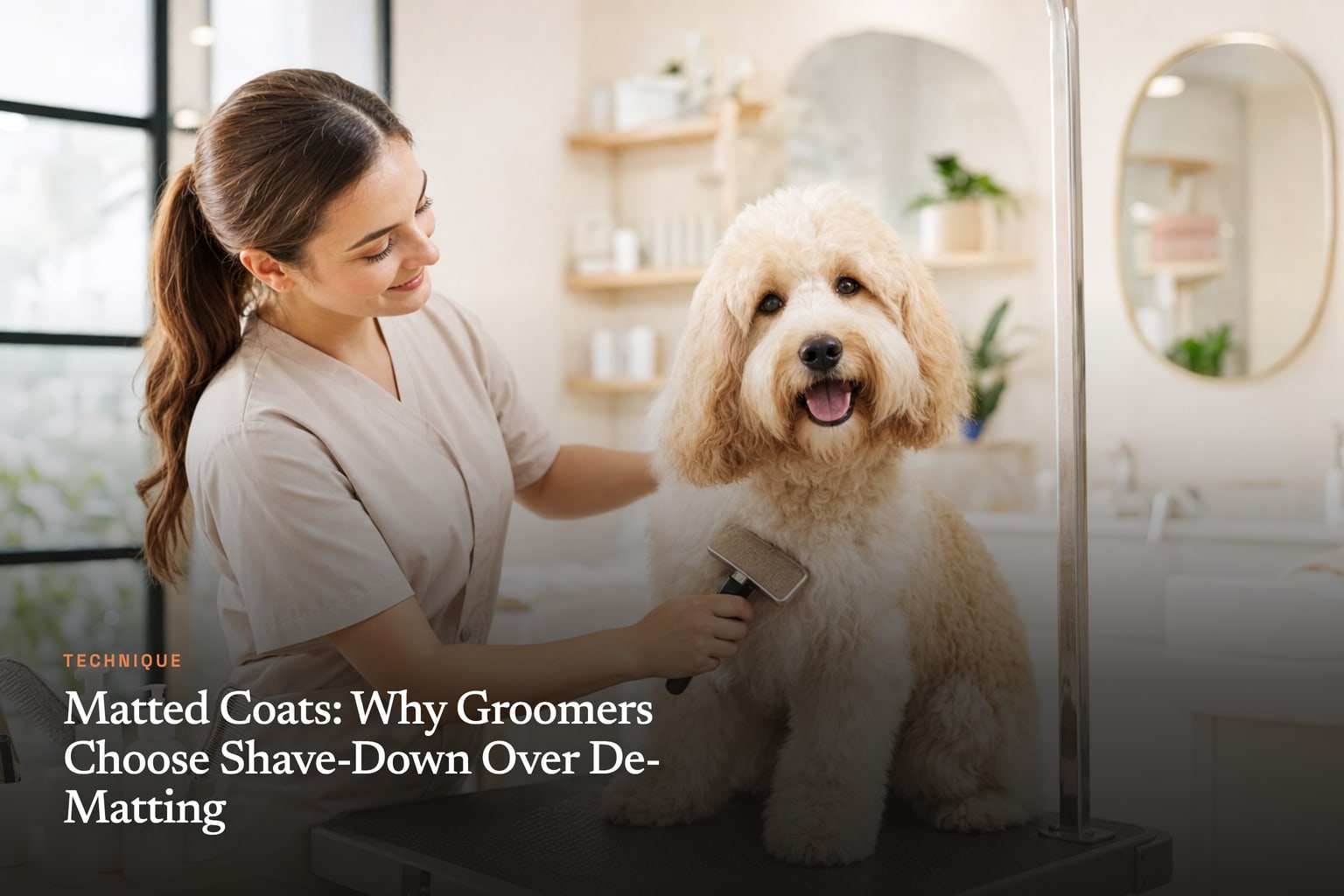
The Welfare-First Standard Reshaping How Groomers Handle Severe Matting
The math on de-matting a pelted dog rarely works, and a growing number of professionals have stopped pretending otherwise. When a coat has tightened to the skin, the choice is no longer stylistic. It is a welfare call, and the industry is increasingly treating it that way.
Both the National Dog Groomers Association of America and the International Professional Groomers have long held positions discouraging aggressive de-matting of severely felted coats. That guidance has quietly become the operating default in more salons over the past two years, driven less by any single new rule than by a shift in how groomers document their decisions and protect both the animal and themselves. The humane shave-down is no longer the reluctant last resort. For pelted coats, it is the standard of care.
When De-Matting Crosses the Line
Not every mat calls for clippers. A dog with a few loose tangles behind the ears and in the armpits is a candidate for careful brushing out, and pretending otherwise is its own kind of malpractice. The distinction that matters is between matting and pelting.
Matting is localized. You can lift the coat, see skin between the tangles, and work a mat out with a slicker, a comb, and patience. Pelting is different. The coat has fused into a solid layer against the body, and the skin moves with it when you tug. That is the signal to put the de-matting tools down.
The widely referenced professional benchmark is simple. If de-matting a section would take more than a few minutes of pulling, or if the process would cause the dog pain, the humane option is to clip. Prolonged brushing of a pelted coat produces brush burn, breaks skin, and inflicts stress that no finished look justifies. NDGAA and IPG guidance both frame this in terms the courts and welfare officers understand: the comfort of the animal outranks the preference of the owner.
The Ten-Minute Rule and Why It Holds Up
Many experienced groomers work to a version of a ten-minute rule, sometimes tighter. If de-matting a specific area would take longer than roughly ten minutes of concentrated work, or if it would clearly hurt, the coat comes off. The rule is not arbitrary. It reflects what prolonged pulling does to skin and to the dog's trust. Ten minutes of a slicker dragging against tension is ten minutes of low-grade pain, and a dog remembers that the next time it is on the table.
The rule also protects the groomer from the slow creep of sunk cost. It is easy to start brushing a bad coat, tell yourself you are almost through it, and keep going for forty minutes while the dog gets more distressed and the skin gets more abraded. A stated rule turns the decision into a checkpoint instead of a running negotiation with your own optimism.
Reading the Coat Before You Reach for a Tool
A defensible decision starts with a defensible assessment. Experienced groomers run a consistent check at intake rather than discovering the problem mid-groom.
- The lift test: can you lift the coat away from the body and see skin, or does the whole layer move as one?
- The comb test: does a comb pass through to the skin at the base, or does it stop at a felted wall?
- Skin condition underneath: pelting traps moisture, urine, and debris, and the skin beneath is often inflamed, hot, or broken before you ever touch it.
- Heat and odor: a sour smell and warmth signal trapped moisture and possible infection, which changes the job from grooming to something closer to triage.
What surfaces under a pelt is frequently worse than the owner expects. Hot spots, sores, fly strike, embedded foreign material, and in some cases masses hidden by the coat. This is exactly why blind de-matting is risky. You cannot see what you are dragging a slicker across. Document the coat state before you start, ideally with photos, and note it on the service ticket.
Grading Matting So Everyone Speaks the Same Language
Some salons formalize the assessment with a simple severity scale, and it pays off in both pricing and communication. A common structure runs from a mild grade, where tangles are surface-level and brush out cleanly, up through a moderate grade with dense mats that still permit safe removal in sections, to a severe or pelted grade where the coat is fused to the skin. Assigning a grade at intake gives the front desk a consistent basis for quoting, gives the groomer cover for the method chosen, and gives the owner a concrete answer to why this visit costs more than the last one.
The grade should live on the ticket alongside the photos. When a coat is documented as a severe pelt with visible skin irritation, the shave-down decision is no longer a matter of one groomer's opinion. It is a recorded clinical judgment, and that is precisely what protects the business if the owner complains later.
The Skin Under the Pelt
Pelting is not only a coat problem. It is a skin problem waiting to be uncovered, and the shave is often the first time anyone sees what has been developing for weeks. Trapped moisture against warm skin is an ideal environment for bacterial and yeast infection. Urine and feces caught in a matted rear cause scalding. A pelt that has pulled tight over a joint can restrict movement and circulation.
This is why the shave itself demands care, not speed. Clipping a pelt means working a blade under a rigid mat that sits flush against fragile, possibly compromised skin. Skin folds are hidden. Nipples, warts, and skin tags disappear under the felt. Groomers who do this work well go slow, use a fresh sharp blade to reduce drag and heat, and keep the blade flat rather than digging. Blade heat is its own hazard on a long job, so professionals check temperature often and swap or cool blades to avoid clipper burn on skin that is already inflamed.
Pricing the Decision Honestly
A shave-down on a pelted dog is not a discount haircut. It is slow, high-risk work performed over compromised skin with a real chance of nicking the animal through no fault of technique. Pricing should reflect that, and building the structure before the dog is on the table keeps the conversation professional rather than defensive.
Most salons that handle matting well use one of two approaches. The first is a matting surcharge added to the base groom, often tiered by severity, so a lightly tangled dog pays less than a fully pelted one. The second is time-based pricing, billing the removal work at the shop's hourly rate on top of the standard service. Either way, the number is disclosed at drop-off, not sprung at pickup.
The consistent professional advice is to charge for the difficulty and the liability, not to compete on price for a job that carries genuine risk. Undercharging trains clients to neglect the coat and leaves the groomer absorbing the cost of that neglect. It also, quietly, incentivizes cutting corners on a procedure where corners injure animals.
Tying the tiered surcharge to the severity grade closes the loop. If your ticket already records a coat as moderate or severe, the price follows automatically, and the front desk never has to improvise a number under pressure. Booking software such as Talopet can store a pet's matting history from visit to visit, which turns a recurring problem into a documented pattern the owner can see and gives the salon grounds to require a shorter maintenance cut before the next appointment.
Getting the Owner to Yes
The hardest part is often not the clipping. It is the conversation with an owner attached to a long coat who does not grasp why their dog cannot keep it.
Lead with the animal, not the aesthetics. Owners rarely argue when the framing is comfort and health rather than convenience. Show them the pelt. Let them feel how the coat moves against the skin. Explain in plain terms that brushing it out would hurt their dog and would take hours the dog cannot tolerate. Most people say yes quickly once they understand it is a welfare issue and not a groomer taking the easy road.
Set expectations for what a shave reveals. Warn that the skin underneath may look red, may have sores, and may have a shave line that looks stark against the remaining coat. Warn too that a shaved dog behaves differently for a day, sometimes cold, sometimes suddenly playful once the weight is gone. And put the recovery plan in writing: a brushing schedule, a realistic bath interval, and a shorter maintenance cut going forward so the salon is not clipping a pelt every visit.
The Release Form and the Photo Record
A short release form covering severe matting, the possibility of pre-existing skin conditions, and the risk of nicks during removal is now common practice, and for good reason. It protects the relationship as much as the business. The strongest version pairs the signed form with timestamped photos taken at intake, so the coat state is documented before a single tool touches the dog. If a sore surfaces mid-shave, photograph it too, and show the owner at pickup. Owners who see the evidence rarely dispute the outcome.
When the standard is welfare-first, transparent, and priced honestly, the shave-down stops being a conflict and becomes what it should be: the responsible choice, made together. The groomer who documents the coat, explains the reasoning, and prices the work fairly is not losing a client. They are teaching one, and the owner who understands why the coat came off is the owner who books a maintenance schedule that keeps it from happening again.