Grooming Clipper Innovations 2026: What Salons Should Know
Brushless motors, longer battery life and better heat management define 2026 grooming clippers. Here is what actually matters before you upgrade.
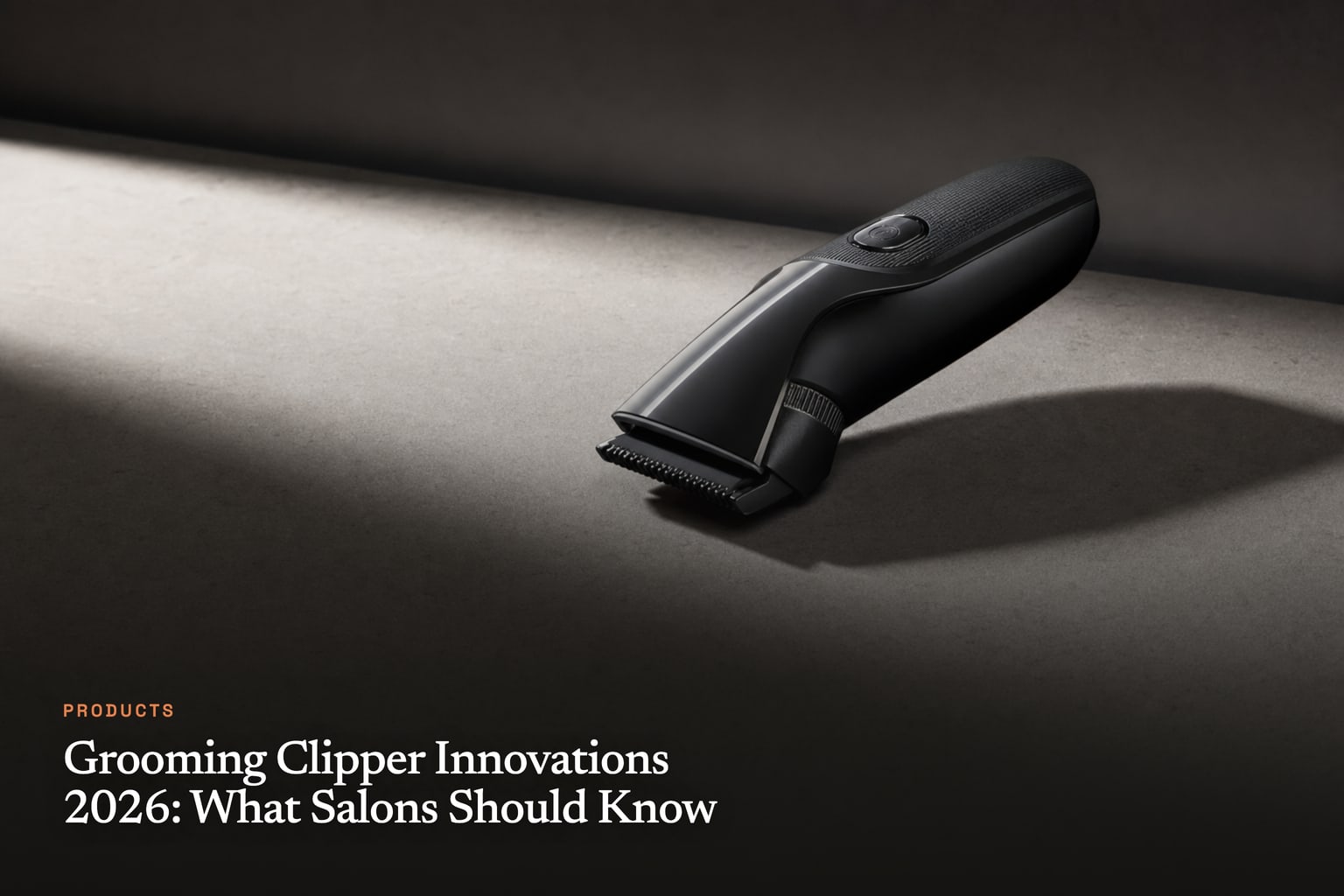
Grooming Clipper Innovations 2026: What Actually Matters Before You Upgrade
The pitch from every manufacturer this year sounds the same. Brushless. Cordless. All-day runtime. But the gap between marketing copy and shop-floor reality is wider than most groomers realize, and equipment budgets in 2026 are tight enough that a wrong call on a $300 clipper stings for a full season.
Here is what changed on the workbench, and what deserves your money.
Brushless Motors Move From Premium to Baseline
The biggest shift is under the housing. Brushless DC motors, once reserved for flagship models, are now the expected standard on any serious cordless clipper. The reason is practical. Brushless designs run cooler, last longer, and hold torque under load far better than the old brushed motors that bogged down in a matted doodle coat.
Andis pushed this hard with its cordless lineup, and the Pulse ZR II remains a workhorse in high-volume salons precisely because the motor does not stall when you hit dense undercoat. Wahl's Bravura and Arco lines lean on the same principle for lighter, finish-focused work. Heiniger, the Swiss maker that has quietly supplied livestock and show-dog operations since 1946, built its Saphir and Xperience cordless units around powerful brushless motors paired with genuinely balanced ergonomics.
The takeaway for buyers is simple. If a cordless clipper in 2026 still uses a brushed motor at a premium price, it is overpriced. Brushless is no longer a luxury feature. It is the floor.
It helps to understand why the difference is real rather than a spec-sheet talking point. A brushed motor uses physical carbon brushes that press against a spinning commutator to transfer current. Those brushes wear down, throw fine carbon dust into the housing, and create friction that becomes heat. A brushless motor swaps that mechanical contact for electronic commutation, so there is nothing rubbing itself away every time you pull the trigger. Fewer moving parts in contact means less heat, less noise, and a motor that holds its rated speed deep into a long day instead of fading as it warms up. For a shop running a clipper through fifteen or twenty coats, that consistency is the whole point.
Battery Life and the Swappable Pack Question
Runtime claims are where the marketing gets loose. A manufacturer quoting "90 minutes" is measuring a fresh battery cutting air, not four hours of shaving through a matted Newfoundland.
The smarter innovation is not longer single-charge runtime. It is the swappable lithium-ion pack. Heiniger built the Saphir specifically around this idea, shipping the clipper with two batteries so a groomer can rotate packs and never stop working. Andis and Wahl have moved toward removable or quick-swap batteries across their detachable-blade cordless range for the same reason. A clipper welded to a sealed internal battery is a liability in a busy shop, because when that cell degrades in eighteen months you are replacing the whole tool.
When evaluating battery specs, ignore the headline number and ask three things:
- Is the battery user-replaceable, and what does a spare cost?
- Does the clipper run while charging or plugged in, giving you a corded fallback?
- How long is the full charge cycle, and can it fast-charge between clients?
A clipper that dies mid-groom with no backup pack and a two-hour recharge is a scheduling problem, not a tool.
There is also a hidden cost in lithium-ion chemistry that catalog pages never mention. Every rechargeable pack has a finite number of charge cycles before its usable capacity drops noticeably, often somewhere between 300 and 500 full cycles for the cells used in grooming tools. A busy groomer who charges daily can reach that point in under two years. When you buy, price the replacement pack before you buy the clipper, not after. A $250 clipper with a $90 replacement battery is a very different long-term proposition than a $320 clipper with a $35 pack. The cheaper tool up front can quietly become the expensive one over five years, and that is exactly the kind of math that separates owners who protect their margins from owners who chase the lowest sticker.
Storage habits matter too. Lithium cells last longest stored around half charge in a cool spot, not drained flat or left on the charger indefinitely. Train your team to rotate packs rather than run one into the ground, and the whole fleet ages more gracefully.
Heat Management Is the Real Differentiator
Ask any experienced groomer what ruins a blade, and the answer is heat. Blades running hot mean nicked skin, stressed dogs, and shortened blade life. The 2026 improvements here are subtle but they matter more than any spec sheet number.
Two things are happening. First, the cooler-running brushless motors transfer less heat into the blade housing over a long day. Second, ceramic and ceramic-edge blades continue to gain ground because ceramic conducts far less heat than steel. Andis and Wahl both sell ceramic-edge detachable blades that stay usable noticeably longer between breaks. Oster, whose A5 blade standard still defines cross-compatibility across the industry, keeps its CryogenX and ceramic blade options in wide rotation for exactly this reason.
The practical advice has not changed. Blade coolant spray, a spare set of blades in rotation, and regular oiling still do more for heat control than any single clipper purchase. But a cooler-running motor buys you real minutes of comfortable cutting, and on a ten-dog day those minutes add up.
Building a Blade Rotation That Actually Protects Skin
The single most effective heat strategy costs almost nothing and gets ignored constantly. Rotate two identical blades through a long groom. When one blade climbs to the point where you would not hold it against your own wrist, swap it out, oil it, and set it on a cooling mat while the second blade does the work. A groomer who owns two of a frequently used blade, say a 10 or a 7F, can keep cutting all day without ever running steel hot enough to burn. The classic test still holds: touch the blade to the inside of your forearm every few minutes. If it is uncomfortable on your skin, it is far worse on a dog's belly or under the tail where the skin is thinnest.
Coolant sprays cool fast but briefly, so treat them as a top-up rather than a substitute for rotation. Oiling is the quieter hero. A few drops across the teeth before each dog, wiped down, keeps the blade gliding instead of dragging, and a blade that glides generates less friction heat in the first place. Neglected, oil-starved blades are the leading cause of the mystery clipper burn that shows up as an irritated stripe a day after the appointment.
Blade Compatibility Still Rules the Buying Decision
Here is the quiet economics of clipper buying that manufacturers rarely lead with. Your blade collection is worth more than your clipper.
The Oster A5 detachable-blade standard remains the backbone of professional grooming, and the smartest 2026 cordless clippers, including Andis and Wahl detachable models, accept that universal blade mount. That means a shop switching clippers does not throw away a drawer full of expensive blades. Adjustable-blade clippers such as the Wahl Arco and Bravura use their own five-in-one or dedicated blade systems, which are excellent for finish and face work but lock you into that ecosystem.
Before upgrading, inventory what you own. A clipper that forces you to rebuild a blade collection can double the true cost of the switch.
Think about the two clipper roles most shops actually run. There is the bulk-work clipper that lives on the table for body clips and de-matting, and it should take A5 detachable blades so it shares the drawer with everything else you own. Then there is the light, nimble finishing tool for faces, feet, and sanitary trims, and here the five-in-one adjustable systems earn their keep because you can dial the length on the fly without stopping to switch blades. Buying with those two jobs in mind prevents the common mistake of paying flagship money for a tool that duplicates something already on the bench.
Corded, Cordless, or Both
Cordless dominates the marketing, but the corded clipper is not dead, and pretending otherwise costs shops money. A corded rotary-motor clipper delivers relentless, unfading power with zero battery anxiety, which is why many groomers still reach for one on heavy de-shed and thick double coats where the tool runs for long stretches. The honest 2026 setup for a full-service salon is usually a mix: a corded workhorse for the punishing coats, a cordless brushless unit for maneuverability and awkward angles, and a small trimmer for detail. Framing the decision as cordless-versus-corded misses the point. The question is which tool suits which task on your table.
What Actually Justifies an Upgrade
Not every salon needs new clippers in 2026. The honest test is whether your current tools cost you time or comfort. Consider upgrading if:
- Your corded clippers force awkward positioning that slows every groom.
- Motors bog down on dense or matted coats, forcing repeat passes.
- Blades overheat fast because an older brushed motor runs hot.
- Battery packs on existing cordless units are dying and cannot be replaced.
If none of those apply, hold your budget. The most overhyped purchases this year are marginal battery-life bumps on tools that do the same job as last year's model. The genuine gains are brushless torque, swappable batteries, and cooler operation. Weigh those against your actual pain points rather than the newest catalog page, and the upgrade decision usually answers itself.
A Simple Buying Checklist
When you do decide to spend, walk through this before you commit:
- Confirm the motor is brushless and ask about the warranty term specifically on the motor, not just the tool.
- Verify the battery is user-replaceable and get the price of a spare in writing.
- Check that the blade mount matches your existing drawer, or budget honestly for new blades.
- Hold the tool in your hand if you can. Balance, weight, and noise at the ear decide whether your team actually reaches for it.
- Ask about service. A clipper you can send in for a motor rebuild outlasts one you throw away.
The tools got genuinely better this year. Brushless motors are quieter and cooler, swappable batteries keep a busy chair moving, and ceramic blades stretch the working window between cooldowns. None of that changes the fundamentals. The best clipper for your shop is the one that matches your coats, shares your blade collection, and holds up to the number of dogs you actually run. Buy for that, not for the box.